What is a PPS murmur?
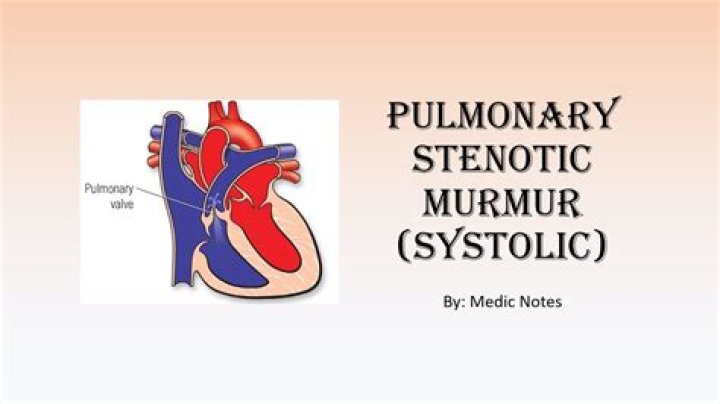
Peripheral pulmonic stenosis (PPS), also referred to as peripheral pulmonary stenosis or pulmonary branch stenosis, is a narrowing within one or more branches of the pulmonary arteries that manifests on physical exam as a systolic ejection murmur in infants. This murmur is often an incidental finding in neonates.Click to see full answer. Also, what does a PPS murmur sound like?This murmur can often be heard as a distinct sound along the left front chest, the back and the sides of the infant. In newborns with otherwise normal hearts, PPS is usually a benign/innocent occurrence and will resolve on its own. In these mild cases, typically no treatment is required.Similarly, what is a pulmonary flow murmur? A pulmonary flow murmur is just like it sounds. In a pulmonary flow murmur, all you are hearing is normal blood flow across a normal pulmonary valve. Blood is a liquid, and it flows through the heart fairly rapidly in some cases. Sometimes this normal flow can produce extra sounds or noises. Beside above, what is PPS in cardiology? Peripheral Pulmonic Stenosis (PPS) is the narrowing in the pulmonary arteries that take blood from the heart to the lungs. This is common in babies and usually goes away on its own. The narrowing develops because before birth, there is less blood flow to the lungs.What is peripheral stenosis?Peripheral pulmonary stenosis is a narrowing in one or more of the branches of the pulmonary arteries. These are the arteries that carry blood from the heart to the lungs. Peripheral pulmonary stenosis is typically a congenital heart defect — a condition a child is born with.